
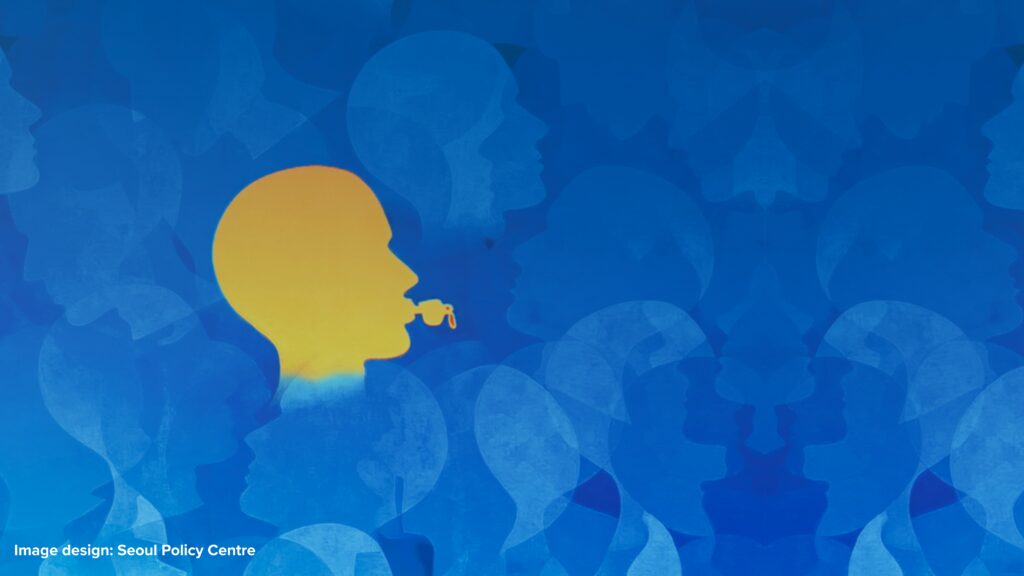
Whistleblower protection is widely recognized as a cornerstone of effective anti-corruption efforts and good governance. Yet in many countries, legal frameworks exist on paper while fear of retaliation, lack of confidentiality, and weak enforcement continue to discourage individuals from reporting wrongdoing. Bridging the gap between policy intent and practical impact is therefore a central priority for anti-corruption efforts worldwide.
A new policy brief from the United Nations Development Program (UNDP) Seoul Policy Centre (USPC), developed in partnership with the Anti-Corruption & Civil Rights Commission (ACRC) of the Republic of Korea (ROK), examines how the ROK has built one of the most comprehensive whistleblower protection systems in the world, and what other countries can draw from that experience.
Here are three critical steps that ROK has taken to establish an effective whistleblower protection system.
1. Strong institutional foundation evolved to enable integrated, whole-of-government approach to protect whistleblowers
The Republic of Korea’s whistleblower protection system has evolved gradually, shaped by international anti-corruption norms and sustained political commitment. The first formal mechanisms for reporting wrongdoing in the public sector came with the Anti-Corruption Act of 2001. A decade later, the Public Interest Whistleblower Protection Act (PIWPA) significantly expanded coverage to include violations related to public health, safety, environment, and consumer rights. The establishment of the ACRC in 2008 was equally pivotal, consolidating anti-corruption and ombudsman functions into a single independent body and replacing fragmented handling across multiple agencies with a coherent, whole-of-government approach.
2. Robust legal and operational mechanisms to protect whistleblowers’ identity
Building on the institutional foundation, the ROK model combines legal guarantees with progressively strengthened enforcement mechanisms. Confidentiality is protected by law, with criminal penalties for disclosing a whistleblower’s identity without consent. To further shield identity, whistleblowers may submit reports through an attorney, with legal fees covered under recent amendments. Should a whistleblower face retaliation in the workplace, the burden of proof shifts to the employer to demonstrate that any adverse action was unrelated to the disclosure, thereby reinforcing protection in practice. Recent amendments have further strengthened compliance requirements and introduced legal consequences for non-compliance with ACRC protective orders. Beyond protection from retaliation, whistleblowers also have access to free legal assistance, financial relief for lost income or relocation costs, and in some cases psychological counselling and career support.
3. Establishment of digital portal to lower the barriers of reporting
The Clean Portal, a digital one-stop reporting platform, connects more than 1,100 public organizations, and has contributed to lowering barriers to reporting as part of a broader system combining legal, institutional and technological measures. It automatically routes cases to the relevant authority, embeds protection requests from the outset, and allows whistleblowers to track their case while their identity remains protected. Reports can be submitted around the clock in Korean or English, with mail, telephone, and in-person alternatives also available. Since the system was established, public interest reports have grown more than tenfold, from 292 cases in 2011 to 3,266 in 2022, reflecting a significant shift in reporting culture.
Scalability and Transferability: Insights from the ROK Model
The policy brief also addresses the scalability of the ROK system. The ROK system is resource-intensive, relying on advanced digital infrastructure, a well-funded central institution, and high levels of institutional capacity, making direct replication challenging in lower-capacity contexts. The model’s effectiveness also depends heavily on the integrity and capacity of key institutions such as the ACRC, prosecutors, and the judiciary, as well as sustained enforcement and public trust. Research further suggests that legal reforms alone may produce only a short-term increase in reporting unless accompanied by sustained managerial commitment and cultural change, as hierarchical workplace cultures and social norms can still deter disclosures even where legal protections are in place.
For these reasons, the brief emphasizes that the ROK model should serve as a reference point rather than a blueprint, with adaptation required to reflect national legal frameworks, institutional capacity and socio-cultural contexts. Core principles such as confidentiality, protection from retaliation, independent oversight, and recognition of whistleblowers as contributors to the public interest are broadly relevant, but their implementation must be carefully adapted to national circumstances, institutional capacity, and cultural realities. The ROK’s experience nonetheless offers valuable insights for countries seeking to strengthen whistleblower protection as part of broader anti-corruption and governance reforms, and through its SDG Partnership Program on Transparency and Accountability, USPC is already supporting partner countries including Zambia, Tajikistan, Tonga, and Vanuatu in drawing on the ROK model to inform context-specific reforms.
Read the full policy brief: Whistleblower Protection Model of the Republic of Korea, Key Features and Insights